

Local SEO Service
Local SEO is your neighborhood ambassador. I weaponize “near me” searches, dominate city-specific directories, and craft posts that answer hyper-local cravings. Watch map rankings climb, review stars multiply, and your phone ring with ready-to-buy locals.
What is Local SEO?
Local SEO (Local Search Engine Optimization) is the process of improving your business’s online presence so it appears higher in local search results on Google and other search engines. It helps attract nearby customers searching for products or services in a specific area.
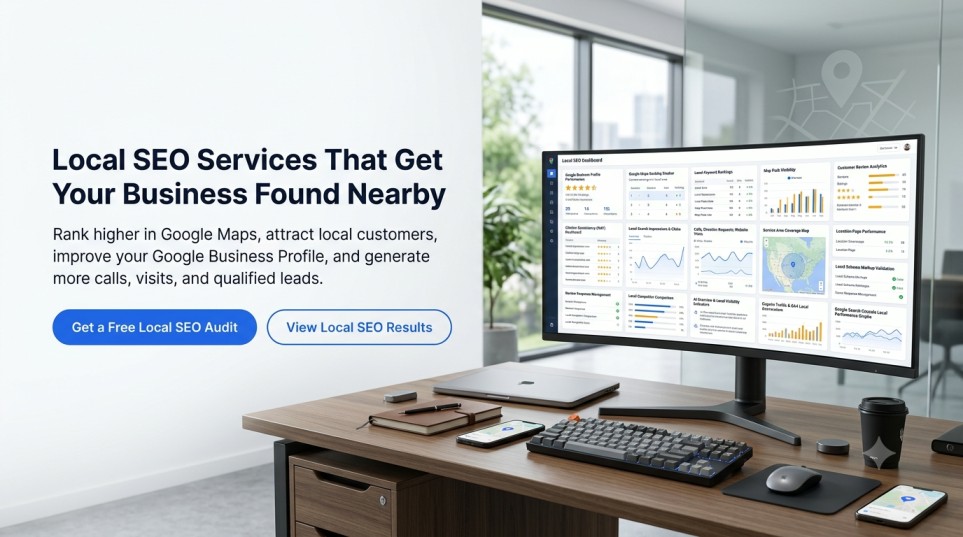
What's Included in My Local SEO Service
- Full Google Business Profile (GBP) setup, optimization, and ongoing management.
- Local citation building and cleanup across major directories.
- On-page local SEO: location pages, service area pages, and schema markup.
- Review generation strategy and reputation management.
- Local keyword research and Google Maps ranking optimization.
- Competitor gap analysis for local search visibility.
- Monthly reporting on rankings, calls, direction requests, and profile views.
What Is the Average Cost of Local SEO Services for Small Businesses?
Local SEO for small businesses typically costs between $300 and $1,500 per month, depending on competition, the number of locations, and how much ongoing optimization (citations, reviews, content) is included. One-time GBP optimization or audit packages can range from $150 to $750.
Is It Better to Pay for Local SEO Monthly or as a One-Time Setup?
A one-time setup fixes your foundation, your Google Business Profile, citations, and on-page basics, but local rankings depend on ongoing signals like new reviews, fresh posts, and updated citations. Most businesses get the best long-term results from an initial setup followed by monthly maintenance, since local search rankings can slip if a profile goes stale.
Why Are Some Local SEO Services So Cheap?
Very cheap local SEO packages (under $100/month) often rely on automated citation submissions, generic templates, or outdated tactics like keyword-stuffed business names. These can sometimes hurt rankings or trigger a Google Business Profile suspension. Sustainable local SEO requires manual optimization, real review generation, and consistent monitoring, which takes real time.
How Do I Know If My Local SEO Service Is Working?
- Your Google Business Profile shows up more often in the Map Pack for relevant searches.
- Direction requests, calls, and website clicks from your GBP insights are trending up.
- You’re ranking for more local keyword variations across more locations.
- New reviews are coming in consistently and being responded to.
- Your citations are consistent (same name, address, and phone number) across directories.
How Do I Rank Higher on Google Maps?
Ranking higher on Google Maps (the Local Map Pack) depends on three core factors: relevance, distance, and prominence. The strongest improvements come from a fully completed and verified Google Business Profile, consistent NAP (Name, Address, Phone) citations, regular customer reviews, and location-relevant content on your website.
Why Was My Google Business Profile Suspended?
- Inconsistent or inaccurate business information (name, address, phone).
- Using a virtual office or residential address that violates Google’s guidelines.
- Keyword stuffing in the business name.
- Multiple listings for the same business or location.
- A spam report from a competitor or user, or suspicious activity flagged by Google’s automated systems.
What Happened to Google My Business?
Google My Business was rebranded to Google Business Profile in 2022. Most management has moved directly into Google Search and Maps rather than a separate app, and the standalone Google My Business app was discontinued. Businesses now manage their profile by searching their business name on Google while signed into the linked account, or through Google Business Profile Manager on desktop.
What Photos Should I Upload to My Google Business Listing?
- A clear, high-resolution logo and cover photo.
- Exterior photos so customers can identify your location.
- Interior photos showing the customer-facing space.
- Team or staff photos to build trust.
- Photos of products, services, or completed work in action.
- Updated seasonal or event photos to keep the profile active.
Why local SEO is important for small businesses?
For small and micro enterprises, local SEO is a core customer acquisition tool. At present, search engines prioritize displaying local results for search queries containing terms such as “near me” or a specific city’s name without implementing this optimization, businesses are highly likely to lose their targeted customer pool.
Operators only need to complete four core tasks:
- Optimize their Google Business Profile
- Unify their business name, address, and phone number across all channels
- Collect authentic customer reviews
- Respond to every review within several days
This practice not only signals account activity to Google but also builds customer trust. It delivers faster results at a lower cost than broad domain marketing, while accurately locking in local customers who are approaching their purchasing decisions.
How To Find The Best SEO Services Near Me For Local Businesses
Start by getting clear on your goals more traffic, leads, or visibility then research local agencies through reviews, Google Business Profile listings, and case studies of past results. Look for providers who offer keyword research, on-page optimization, Google Business Profile management, and quality local backlinks. Avoid agencies promising instant rankings or offering suspiciously cheap prices good local SEO takes time but a nearby agency that knows your market and communicates easily is usually your best bet.
What is the best practice for local SEO on service-based websites?
For local search engine optimization (SEO) of local service websites, the core optimal strategy we recommend is to build dedicated standalone pages for every individual service and every service coverage area, and abandon the generic “services” page that attempts to cover all target keywords.
Search engines match specific user search intent to the corresponding page; for example, a user searching for “Lalitpur drain cleaning services” must be directed to a page that precisely matches their query, rather than the generic homepage.
Standalone pages must include trust signals such as:
- Price ranges
- Service processes
- Photos of completed local projects
- Region-specific user reviews
- Many websites suffer from stagnant search rankings because their region-specific pages have thin, duplicated content. Operators should also add internal links to related service pages and pages for neighboring cities within the same service region.
This site structure consistently outperforms single-page setups or overly broad website building schemes.
Service area businesses (plumbers, electricians, cleaners, contractors) that travel to customers rather than having customers visit a storefront can still rank in local search by setting a defined service area on their Google Business Profile, hiding their exact address if they don’t serve walk-in customers, and building dedicated pages for each city or region they serve.
How to Do Local SEO If I Don’t Have a Physical Office?
- Set up your Google Business Profile as a service area business and define the cities or zip codes you serve.
- Hide your address (Google allows this for service area businesses that don’t see customers on-site).
- Build location or service-area pages on your website for each major area you cover.
- Get reviews from customers tied to specific service locations.
- List your business consistently in directories using your service area instead of a street address.
Does Hiding My Address Hurt My Local Rankings?
Not if it’s set up correctly. Google explicitly supports service area businesses that hide their address. Rankings are still based on your defined service area, business category, reviews, and on-site signals. The key is making sure your service area is accurately configured and your website clearly reflects the areas you serve.
How Many City Pages Should My Local Business Have?
Most service area businesses benefit from one dedicated page per major city or service area, typically the cities or towns that generate meaningful search volume and customer demand. Thin, near-duplicate pages for every small town can hurt more than help. Focus on quality, unique content (local landmarks, project examples, testimonials specific to that area) for 5–15 priority locations rather than dozens of templated pages.
Does Getting Reviews Help with Local SEO?
Yes. Reviews are one of the strongest local ranking signals. The quantity, quality, recency, and diversity of your Google reviews, along with how you respond to them, directly influence your Map Pack rankings and your click-through rate from search results.
How Do I Remove a Fake Google Review?
- Flag the review directly on your Google Business Profile (“Report review”).
- Choose the most accurate reason: spam, conflict of interest, or off-topic content.
- If Google doesn’t remove it automatically, escalate through Google Business Profile support or the Small Business community forum.
- Respond professionally to the review while it’s pending removal, since potential customers can still see it.
Does Google Like It When You Reply to Reviews?
Yes. Responding to reviews, both positive and negative, signals to Google that a business is active and engaged with customers. It also improves trust and conversion rates for people reading your profile. Replies that naturally include relevant keywords (your service, your location) can reinforce relevance signals as well.
What Is the Best Software for Getting More Google Reviews?
There’s no single “best” tool, the right choice depends on your CRM, budget, and team size. Popular review management platforms include Birdeye, Podium, NiceJob, and GatherUp, all of which automate review requests via SMS or email after a service or purchase. For many small businesses, a simple SMS or email follow-up sequence with a direct Google review link performs just as well as paid software.
What Are Local SEO Citations?
A local SEO citation is any online mention of your business’s name, address, and phone number (NAP), typically on directories, review sites, social platforms, or industry-specific listings. Consistent citations across the web help Google verify that your business is legitimate, real, and located where you say it is, which strengthens your local rankings.
Where Should I List My Business for Local SEO?
- Google Business Profile (the most important listing by far).
- Bing Places and Apple Maps.
- General directories: Yelp, Facebook, Better Business Bureau.
- Data aggregators: Foursquare, Neustar Localeze, Data Axle (these feed many smaller directories).
- Industry-specific directories relevant to your business type (e.g., Houzz for contractors, Avvo for lawyers, Healthgrades for medical practices).
- Local directories, chambers of commerce, and regional business associations.
Do Incorrect Business Listings Hurt My SEO?
Yes. Inconsistent business information across the web, an old address, a wrong phone number, or a different business name spelling, confuses Google’s algorithms and can lower trust signals (prominence) for your profile. It can also directly confuse customers, leading to lost calls and visits. Auditing and correcting these listings is a core part of a local SEO citation cleanup.
Is Yelp Still Important for Local SEO?
Yes, though less than it once was. Yelp remains a major citation source and a trusted review platform, especially for restaurants, home services, and consumer-facing businesses. While Yelp itself doesn’t directly boost Google rankings as much as it used to, an accurate, active Yelp profile still contributes to your overall citation consistency and online reputation, both of which matter for local search.
Why Local SEO Matters for AI Search and AI Overviews
AI-powered search results, Google AI Overviews, ChatGPT, Gemini, and Perplexity, increasingly pull local business recommendations from the same underlying signals as traditional local search: Google Business Profile data, structured citations, review sentiment, and well-organized website content with local schema markup. A business with a clean, consistent, well-optimized local presence is far more likely to be surfaced as a trusted recommendation by AI assistants, not just in the traditional Map Pack.
My Local SEO Process
Step 1 – Local SEO Audit
I review your Google Business Profile, current citations, on-page local signals, reviews, and competitor rankings to identify what’s holding you back in the Map Pack and local search results.
Step 2 – Foundation Fixes
- Optimize and fully complete your Google Business Profile.
- Correct and consolidate inconsistent citations across directories.
- Add or fix local business schema markup on your site.
- Set up or refine service area pages and location pages.
Step 3 – Ongoing Growth
- Review generation outreach and reputation management.
- Regular Google Business Profile posts and updates.
- Monthly tracking of Map Pack rankings, calls, and direction requests.
- Ongoing competitor monitoring and citation maintenance.
Let’s Get Your Business Found Locally
Whether you’re a single-location small business, a service area business, or managing multiple locations, I’ll build the local SEO foundation that gets you ranking on Google Maps, earning consistent reviews, and showing up in AI-driven search results.
What is Local SEO?
Local SEO is the process of optimizing your business for location-based search results — like Google Maps and the “near me” section. It helps your company appear when nearby customers search for what you offer.
It includes: optimizing your Google Business Profile, using location-based keywords, and ensuring your business appears in local map packs.
How is Local SEO different from regular SEO?
Local SEO focuses on helping your business show up in map packs, Google Business listings, and proximity-based searches. Regular SEO targets broader keywords across cities, countries, or the globe.
Think: Local SEO = “plumber near me,” while traditional SEO = “how to fix a faucet.”
What is a citation in Local SEO?
A citation is a mention of your business’s name, address, and phone number (NAP) on directories like Yelp, YellowPages, or niche industry sites.
Accurate citations improve NAP consistency and help search engines trust your business directory listings.
Do I need a Google Business Profile?
Yes, having a Google Business Profile (GBP) is essential. It’s your official listing on Google Maps and is one of the biggest ranking factors for local visibility.
I fully handle your GMB optimization from setup to posts.
How long does Local SEO take to show results?
Results usually start appearing in 30 to 90 days, depending on your niche, competition, and how optimized your listings already are.
For most clients, map pack impressions, calls, and local traffic start growing in the first few weeks.
Can you fix duplicate or incorrect listings?
Absolutely. I scan your local listings, identify duplicate or outdated entries, and correct or merge them as needed.
I also clean up your NAP inconsistencies across web directories for better trust and visibility.
How do you track success in Local SEO?
I use a mix of GMB Insights, Google Search Console, and call tracking to measure your visibility and engagement.
You’ll know how many people found you on Maps, clicked your phone number, requested directions and exactly where you’re ranking locally.
Is Local SEO relevant for voice searches?
Yes, more than 50% of voice searches have local intent. Queries like “Find a salon near me” pull results based on proximity, device location, and how optimized your GBP is.
I optimize for voice search using schema, question-based keywords, and fast-loading mobile pages.
Do you create location-specific pages?
Yes. I build SEO-optimized landing pages for each city or service area you serve. These pages include hyperlocal keywords, schema markup, and embedded maps.
This helps you rank in every location, not just where your HQ is.
Is this service for startups or bigger brands?
Both. Whether you’re a one-location startup or a multi-city brand, we customize Local SEO to fit your goals.
I serve solo founders, service pros, retail chains, and agencies needing white-label execution.