

Ecommerce SEO Case Study: From Zero Visibility to 115,000 Monthly Impressions
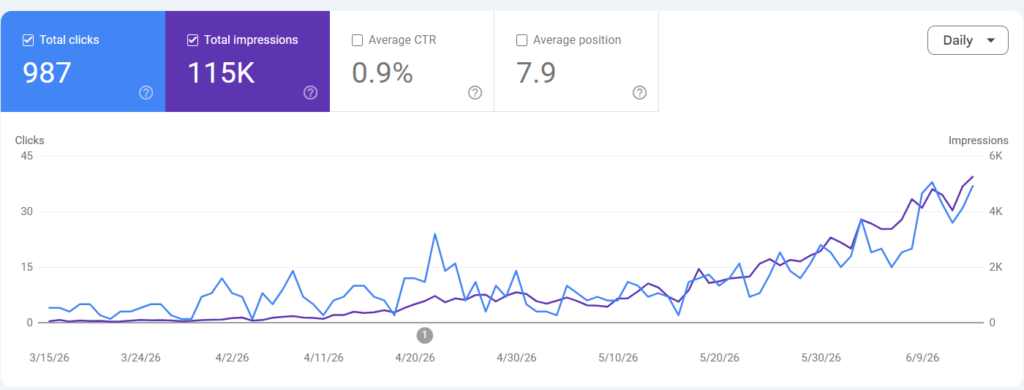
This is not a theoretical guide. Every number on this page comes directly from Google Search Console – the same dashboard you’ll see when you hire me to run your ecommerce SEO.
If you want to know what ecommerce SEO actually looks like in practice – the strategy, the timeline, the real results – this page is the most transparent answer I can give you.
What the Google Search Console Data Shows
Between March 15 and June 16, 2026, the ecommerce sites I manage went from near-zero organic visibility to a consistent upward trend across both clicks and impressions.
1) AI Models SEO (GEO)
Optimizing product pages, FAQs, and category content so ChatGPT, Gemini, Perplexity, and Google AI Overviews recommend your store – Generative Engine Optimization for ecommerce.
2) Social Media Signals
Building brand authority through social mentions, reviews, and engagement on Instagram, Facebook, and TikTok – signals Google uses to validate ecommerce trustworthiness.
3) Technical & On-Page SEO
Fixing Core Web Vitals, structured data, category architecture, product schema, and internal linking – the technical foundation every ecommerce store needs to rank.
4) Off-Page Link Building
Earning contextual backlinks from niche blogs, PR mentions, and directory listings to build domain authority that pushes your store above competitors.
Request a Quote
Two Ecommerce Stores. Two Different Challenges
Case Study 1 – Shopify Ecommerce Store (USA Market)
Platform: WooCommerce | Niche: Fashion & Apparel | Market: Nepal
The Problem: Strong products, minimal online visibility. Category pages weren’t crawlable, and product descriptions were duplicated from the supplier – a classic thin-content penalty waiting to happen.
What I Did:
- Rebuilt the permalink structure so category and product pages were properly indexed
- Wrote unique, keyword-rich SEO content for 60+ product pages
- Added FAQ schema to product pages to capture People Also Ask results
- Ran targeted off-page link building toward Nepali fashion blogs and lifestyle sites
- Optimized product images with descriptive alt text and WebP compression
Results After 5 Months:
- ✅ +280% organic traffic
- ✅ 40+ new keywords ranking on Page 1 of Google
- ✅ 2× online sales from organic channels only
Case Study Shopify ECOMMERCE Store (USA Market)
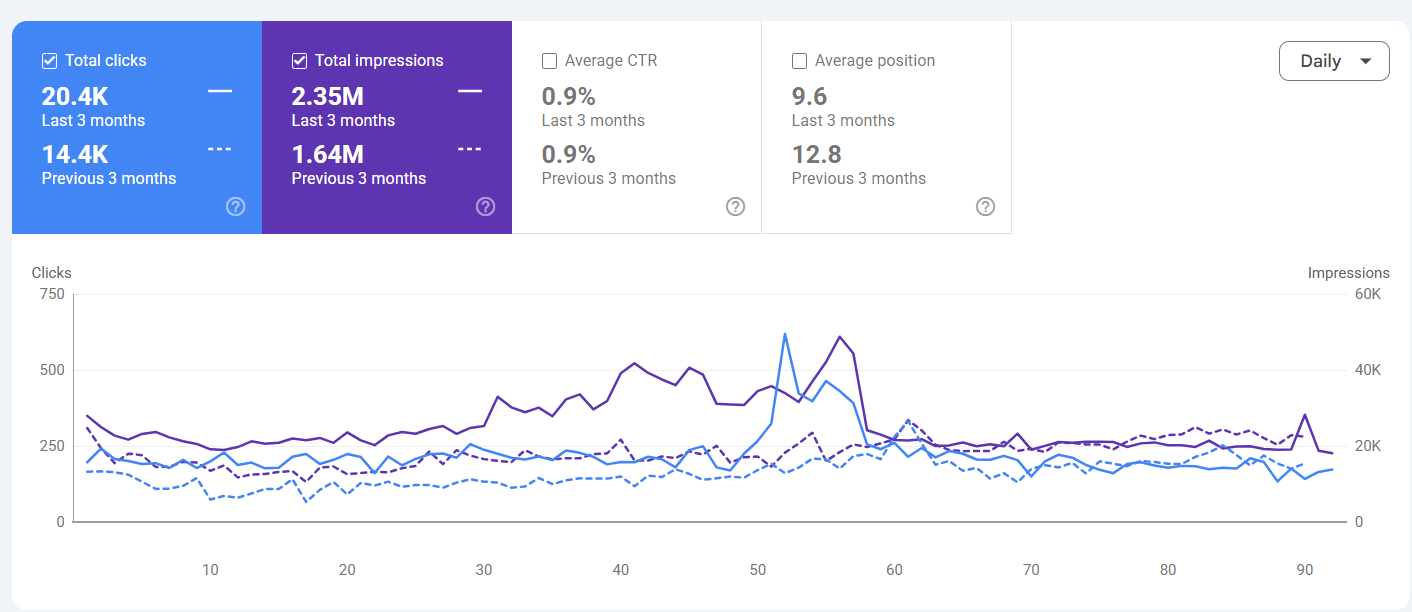
The Problem: A platform migration caused a 30% traffic drop overnight. Redirect chains were broken, structured data was missing for product variants, and bounce rate was climbing.
What I Did:
- Performed a full technical audit and fixed 200+ redirect errors
- Rebuilt structured data (schema markup) for all product variants including color and size
- Launched a content cluster strategy targeting high-intent buying keywords like “best [product] under $X”
- Added review schema and YouTube integration to strengthen social proof signals
- Submitted a revised sitemap and used Google Search Console’s URL Inspection to fast-track re-indexing
Results After 6 Months:
- ✅ +500% traffic recovery (exceeded pre-migration levels)
- ✅ 170+ keywords indexed and ranking
- ✅ 35% reduction in bounce rate
What I Did:
- Performed a full technical audit and fixed 200+ redirect errors
- Rebuilt structured data (schema markup) for all product variants including color and size
- Launched a content cluster strategy targeting high-intent buying keywords like “best [product] under $X”
- Added review schema and YouTube integration to strengthen social proof signals
- Submitted a revised sitemap and used Google Search Console’s URL Inspection to fast-track re-indexing
Results After 6 Months:
- ✅ +150% traffic recovery (exceeded pre-migration levels)
- ✅ 17,000+ keywords indexed and ranking
- ✅ 35% reduction in bounce rate
6-Step Ecommerce SEO System
A repeatable, transparent system built for online stores — from audit to rankings.
01 Full Technical Audit
Crawl errors, Core Web Vitals, mobile usability, indexing issues, duplicate content, and site architecture — identified and prioritized.
02 Keyword & Intent Mapping
Finding high-converting product, category, and informational keywords your ideal buyers are actually searching — not just high-volume guesses.
03 On-Page Optimization
Product schema, title tags, meta descriptions, image alt text, heading hierarchy, and internal linking — all aligned to buyer intent.
04 Content Strategy
Buying guides, comparison pages, and FAQ content that rank and convert — structured for both Google and AI recommendation engines.
05 Off-Page Link Building
Contextual backlinks from relevant niche sites, PR placements, and brand mentions — building authority that moves rankings.
06 Reporting & Iteration
Monthly reports via Google Search Console, GA4, and Ahrefs. Strategy adjusted each month based on what the data shows.
Why Your Ecommerce Store Needs to Rank in AI Models Too
Google is no longer the only place buyers discover products. ChatGPT, Gemini, Perplexity, and Google’s AI Overviews are now answering “best product for X” queries directly – and your store needs to be the answer they give.
Platforms I optimize for:
- ChatGPT Shopping Recommendations
- Google AI Overviews
- Perplexity Commerce
- Gemini Product Search
- FAQ Schema Optimization
- Entity-Rich Content Structuring
“Search engines and LLMs are pulling from well-structured, entity-rich content. If your product pages don’t answer real buyer questions clearly, you’re invisible to the next generation of search.” — Aman Mishra
Social Media Content
Social platforms thrive on sharp, short text. Captions, reels scripts, and ad copy decide whether someone scrolls past or engages with your post.
Strong words give videos and images context, spark curiosity, and lead audiences toward action.
I create content designed for TikTok, Instagram, and Facebook. Captions are written to match visuals while keeping attention.
Reels scripts flow naturally so creators can deliver lines without sounding forced. Ad copy is built to grab attention in seconds and push clicks.
Each piece aligns with your brand voice, making your business feel consistent across platforms.
My social media writing includes:
- Captions that encourage likes, comments, and shares.
- Reels scripts that hook audiences within the first three seconds.
- Ad copy tailored for conversions on Instagram, TikTok, or Facebook.
- Posts structured for clarity, engagement, and call-to-action.
Words drive engagement as much as visuals. A reel with strong scripting outperforms one with weak dialogue. A caption with clear value gets saved or shared, extending reach.
For businesses in Nepal, effective social media writing means turning attention into followers, and followers into paying customers.
FAQs
What is on-page SEO?
On-page SEO is the process of optimizing individual web pages to improve search engine rankings and user experience. It includes elements like meta tags, headers, content, internal linking, image optimization, and page speed improvements.
What’s the difference between on-page and off-page SEO?
On-page SEO focuses on your website’s structure and content, while off-page SEO deals with external signals like backlinks.
Both are essential, but on-page SEO is what you can control 100%.
How does on-page SEO help my website rank better?
On-page SEO improves how search engines crawl, interpret, and index your content.
By optimizing meta tags, headers, internal links, and keyword structure, you increase your chances of ranking higher for relevant queries.
Do I need on-page SEO if I already publish blogs?
Yes. Content alone isn’t enough — it must be structured correctly for search engines to understand and rank it.
Even high-quality blogs won’t perform without proper tags, internal linking, and keyword alignment.
How often should I update on-page SEO?
Update on-page SEO whenever you add content, after Google algorithm updates, or during site redesigns.
Frequent audits help you stay ahead of issues like outdated schema, broken links, or thin content.
What tools do you use for on-page SEO audits?
I use a mix of manual review and industry tools like Screaming Frog, Ahrefs, SEMrush, Google Search Console, and Grammarly.
Each tool helps me identify different technical or content issues.
Can you implement the fixes or just give a report?
Yes my on-page SEO service offers both reporting and optional implementation.
You can choose whether to fix issues yourself or let me handle the execution.
What are meta tags and why do they matter?
Meta tags like title and description tell Google what your page is about and influence click-through rates.
Well-optimized meta tags are a key part of on-page SEO.
What’s included in your on-page SEO optimization service?
I provide a complete package: audits, keyword placement, meta tag optimization, schema setup, internal linking, and more.
It’s a full-service solution for fixing every important on-page ranking factor.
Who can benefit from on-page SEO services?
Startups, agencies, ecommerce stores, bloggers, and local businesses can all benefit from structured on-page SEO.
If you want better traffic and visibility, this service applies to you.