

Custom Code SEO Case Study: Static HTML & JavaScript Sites That Rank
Most SEO case studies show WordPress results. This one is different.
The two projects below were built on static HTML/CSS and JavaScript — no CMS, no SEO plugin, no shortcut. Every canonical tag, every schema block, every sitemap entry was written directly into the codebase.
The Google Search Console data you see on this page is real and unedited. One site grew from near-zero visibility to 667 clicks and 6,760 impressions in under three months. The other, a JavaScript-heavy site, scaled to 40,200 impressions as it climbed from position 19 toward the first page.
If your website was hand-coded or built on a custom framework — React, Next.js, Vue, Laravel, Django, or raw HTML/CSS — this page shows exactly what is possible when SEO is implemented at the code level, not patched on top of it.
Case Study 1: Static HTML/CSS Website - From Invisible to Page One
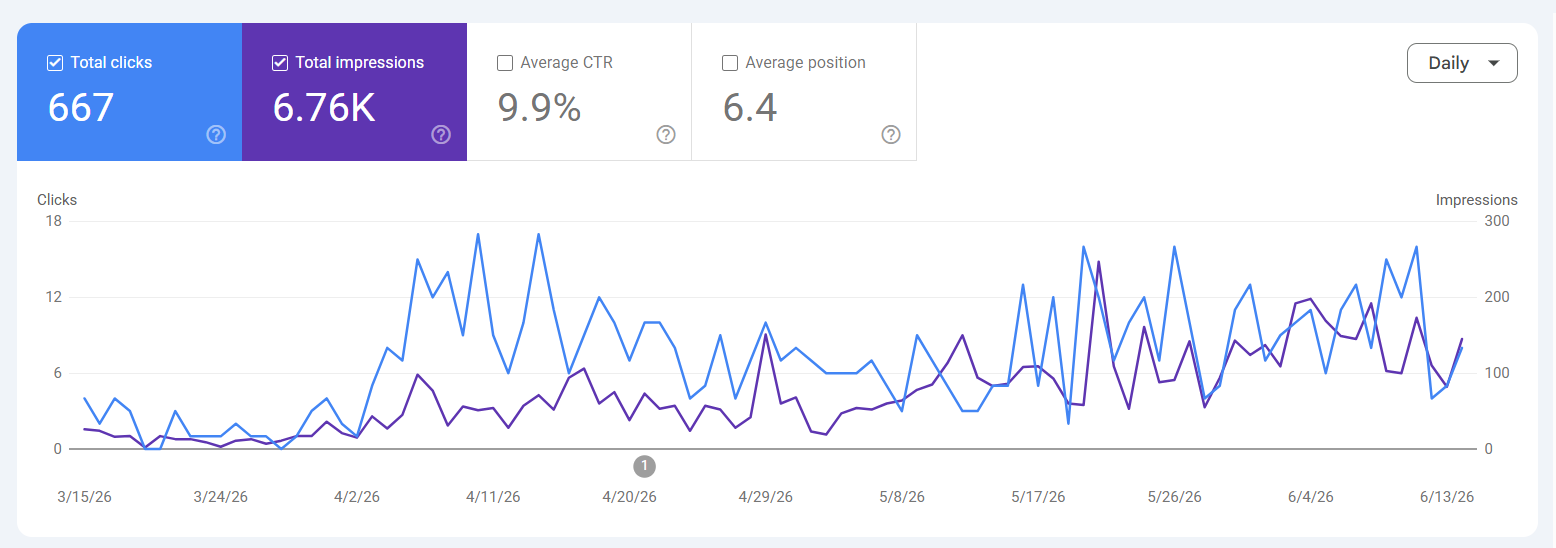
This client’s website was beautifully designed and hand-coded with clean HTML and CSS. The developer had done an excellent job on the visual layer. But from Google’s perspective, the site barely existed.
There was no XML sitemap. No robots.txt. No canonical tags. No structured data. No Open Graph markup. The site had been live for over a year but Google had indexed fewer than a third of its pages because nothing was guiding the crawler.
The site was also competing for service-based keywords in the Nepal market where the average first-page result has thin content and weak structure — meaning a well-optimized static site had a real path to the top.
The Problem
This client’s website was hand-coded with clean HTML and CSS and looked great visually, but Google could barely see it. There was no XML sitemap, no robots.txt, no canonical tags, no structured data, and no Open Graph markup. The site had been live for over a year, yet Google had indexed fewer than a third of its pages because nothing was guiding the crawler.
It was also competing for service-based keywords in the Nepal market, where most first-page results have thin content and weak structure – leaving real room for a well-optimized static site to outrank them.